
Washington, D.C. is dealing with a growing problem at one of America’s most sacred landmarks, and federal officials are sending a clear warning that enough is enough. The Lincoln Memorial Reflecting Pool, recently renovated and reopened to the public, has already suffered visible damage, including peeling blue paint and deteriorating water conditions. U.S. Attorney Jeanine Pirro announced Sunday that anyone caught vandalizing the site will be fully prosecuted, emphasizing that law and order will be enforced in the nation’s capital. Her message was direct: disrespecting American landmarks will come with real consequences.
The reflecting pool, which stretches roughly 2,000 feet between the Lincoln Memorial and the Washington Monument, is more than just a tourist attraction. It is a symbol of American history, where generations have gathered for moments of unity, remembrance, and faith in the country’s future. That is why the rapid decline in its condition—just weeks after a $14.7 million renovation—has struck a nerve with many Americans. The newly applied blue coating, meant to enhance the pool’s appearance, has already begun peeling, raising serious concerns about what caused the damage.
President Donald Trump has pointed to vandalism as the likely cause, suggesting that individuals may have poured harmful or corrosive substances into the water. While officials have not publicly confirmed exactly what was used, the effects are clear. One of the most noticeable problems is an “algae bloom,” which is when microscopic plant-like organisms grow rapidly in water, turning it green, cloudy, and unhealthy. This can happen naturally, but authorities believe outside interference may have accelerated the issue in this case.
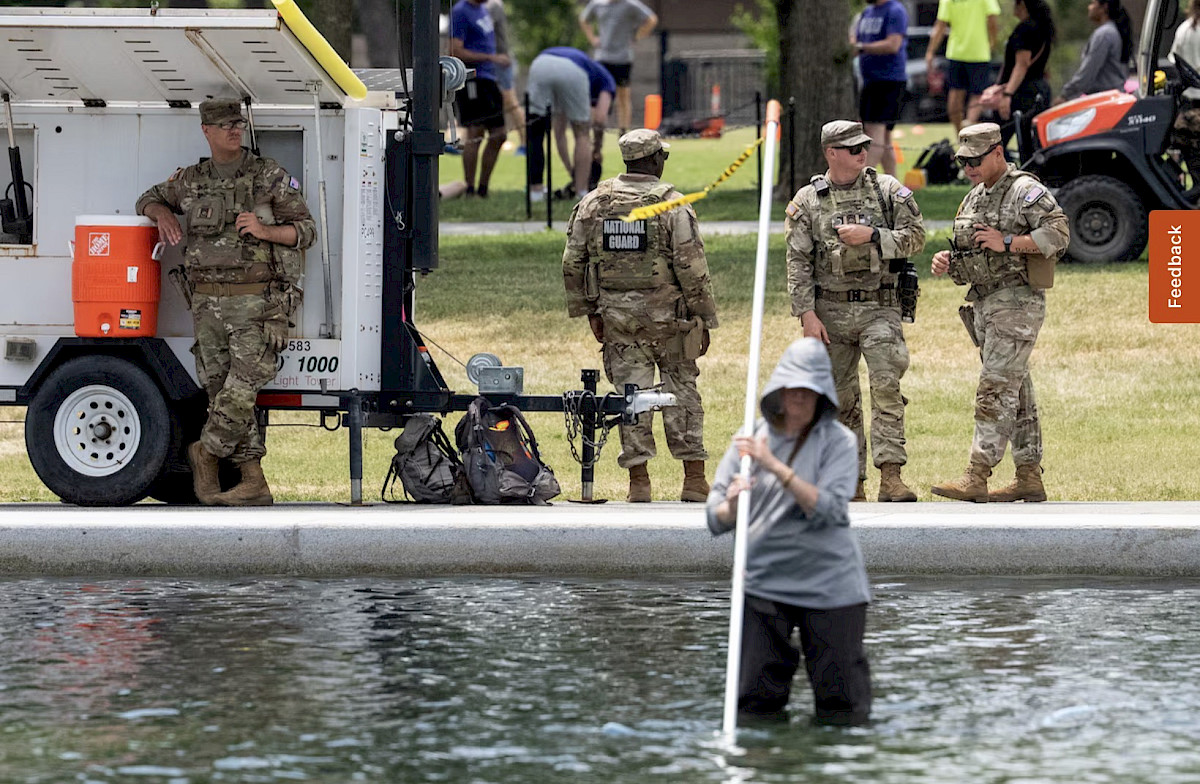
Crews from the National Park Service have been working around the clock to stabilize the situation and restore the pool. Among the methods used is adding hydrogen peroxide, a common chemical that helps break down algae and improve water clarity. While safe in controlled amounts, it highlights just how serious the contamination has become. Officials are also monitoring the structure of the pool itself to ensure no long-term damage has been done beneath the surface.
Law enforcement has already begun issuing citations, and Pirro made it clear that this is only the beginning. She stressed that even minor acts of vandalism will not be brushed aside, especially when they involve national landmarks that belong to every American. The goal, she explained, is simple: restore order, protect public spaces, and send a message that criminal behavior will not be tolerated in Washington, D.C.
The situation has also sparked broader frustration among Americans who see the incident as part of a larger pattern of disrespect toward the nation’s history and institutions. While some critics have questioned aspects of the renovation project itself, supporters argue that the core issue is not politics or construction—it is personal responsibility. Damaging public property, especially something as iconic as the reflecting pool, is not protest or expression. It is a crime, and federal authorities are making it clear that those responsible will be held accountable.
As repairs continue and the investigation unfolds, one thing remains certain: the Lincoln Memorial Reflecting Pool is not just water and stone. It is a symbol of the country’s identity, values, and shared heritage. And for many Americans, protecting it is not optional—it is a duty.